
The Method
What is Joymaking?
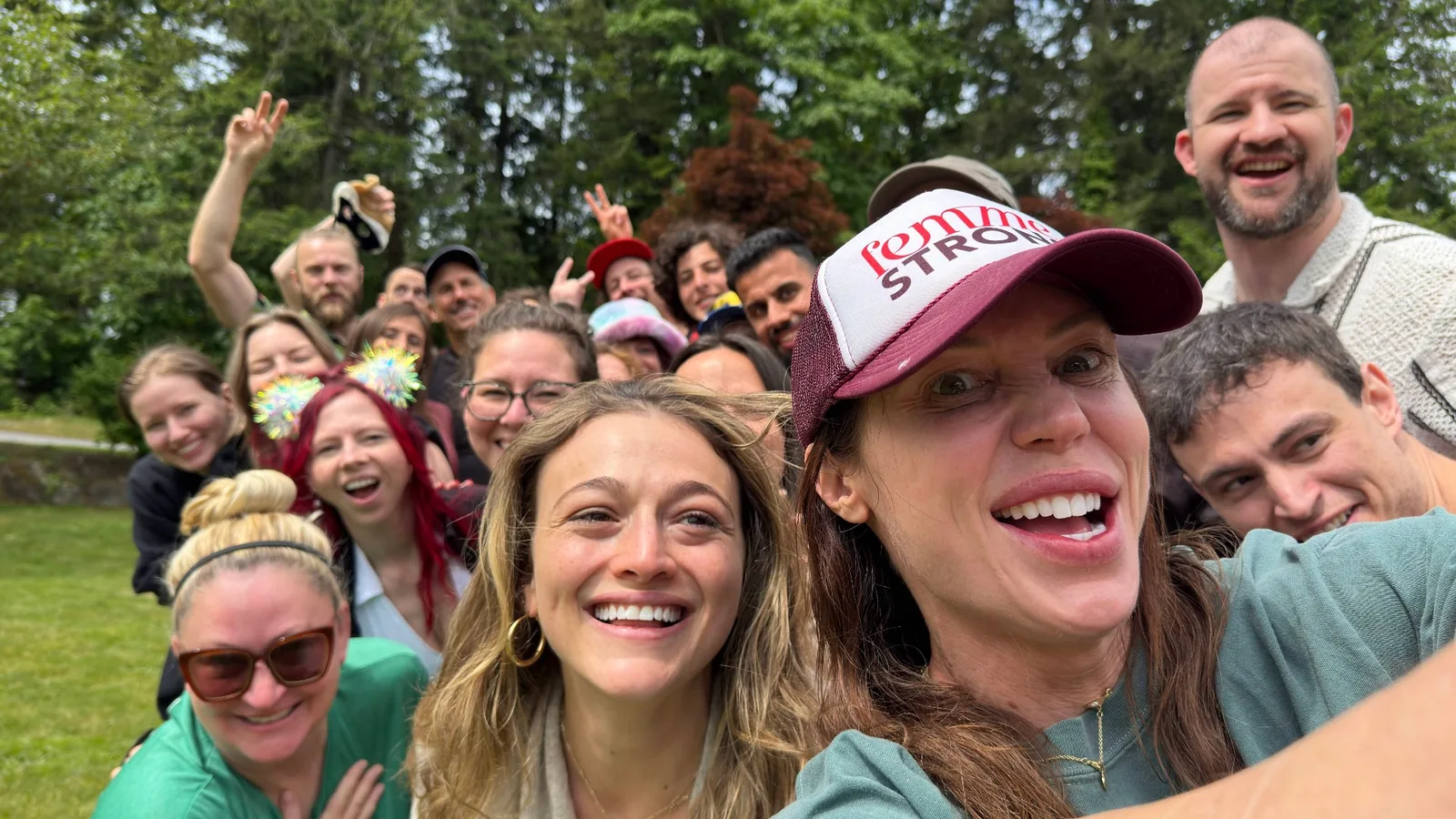
Joymaking is the practice of intentionally creating more joy, energy, connection and participation in groups. A Joymaker is someone who learns to bring rooms to life through play, human connection, group activation and joyful leadership.
It is a learnable skill set, not a personality type. Below: where the term comes from, what the research says, how it differs from facilitation, the six core skills, and how to start practising this week.
The Joymaking ecosystem
Five words, one hierarchy. Joymaking is the umbrella method; everything else is a level of it.
- Joymaker Rebellion
The movement — thousands of people refusing passive, lifeless social culture.
- Joymaking
The practice — the art and science of bringing people to life.
- Joymaker
The person — someone who intentionally creates joy, energy, connection and participation.
- Group Activation
The professional skill — applying Joymaking to a room, a team, an audience or an event.
- Joymaker Camp
The place you master it — immersive Joymaking training.
What is a Joymaker?
A Joymaker is someone remembered and valued for bringing rooms, conversations and groups to life wherever they go. Not the loudest person. Not the entertainer. The person whose presence reliably makes it easier for everyone else to relax, participate and be themselves.
The defining trait is not charisma — it's initiative. Joymakers go first. They ask the question nobody else asks, start the thing nobody else starts, and absorb the two seconds of social risk that unlock the room for everyone else. Most people are perfectly capable of this and simply hesitate. Joymaking is the training that removes the hesitation.
That's why Joymakers come from everywhere: facilitators, teachers, managers, nurses, event producers, community organisers, and thousands of people with no professional stake at all who just refuse to accept that a room has to be dead.
The science of Joymaking
Joymaking is a practice, not a study — but every mechanism it uses is well documented. Seven findings that explain why it works.
Connection is a health variable, not a luxury.
The Harvard Study of Adult Development has followed participants since 1938 and found that the quality of people's relationships was a stronger predictor of long-term health and happiness than cholesterol levels or social class.
Harvard Study of Adult Development ↗The 'weak ties' Joymaking creates genuinely move wellbeing.
Sandstrom & Dunn found that people experienced greater happiness and a greater sense of belonging on days when they had more interactions with acquaintances — not just with close friends and family.
Sandstrom & Dunn, Personality and Social Psychology Bulletin (2014) ↗People systematically underestimate how good connecting will feel.
Epley & Schroeder's commuter studies showed that participants who were asked to talk to a stranger had a more positive experience than those who sat in solitude — yet people predicted the opposite. This forecasting error is exactly the hesitation a Joymaker overrides.
Epley & Schroeder, Journal of Experimental Psychology: General (2014) ↗Doing things in sync makes groups cooperate.
Wiltermuth & Heath demonstrated that synchronous activity — moving, singing or marching together — increased cooperation and trust in subsequent group tasks. It is the mechanism behind almost every good group game.
Wiltermuth & Heath, Psychological Science (2009) ↗Positive emotion widens what a group can do.
Fredrickson's broaden-and-build theory shows that positive emotions expand attention and thought-action repertoires and build durable personal resources. A joyful room is not a distraction from the work — it is a room with more cognitive range.
Fredrickson, American Psychologist (2001) ↗Collective effervescence is a real, measurable effect.
Rimé & Páez's review of Durkheim's theory of collective assemblies documents how shared, emotionally charged gatherings produce lasting increases in social cohesion, meaning and identification with the group.
Rimé & Páez, Perspectives on Psychological Science (2023) ↗Closeness can be deliberately engineered.
Aron and colleagues generated interpersonal closeness between strangers in under an hour using nothing but a structured sequence of escalating personal questions. Connection responds to design.
Aron et al., Personality and Social Psychology Bulletin (1997) ↗These studies describe general psychological mechanisms. They are context for the practice, not claims about outcomes from any specific Joymaker Rebellion program.
Joymaking vs. facilitation (and everything else)
Facilitation
manages a process so a group reaches an outcome. It is largely neutral — the facilitator holds the container.
Joymaking: Joymaking raises the state of a group. It is not neutral: the Joymaker actively injects energy, play and warmth, then hands it back to the room.
Entertainment
performs at a room. The audience receives. When the performer stops, the energy stops.
Joymaking: Joymaking activates a room. The people become the source. When the Joymaker steps back, the energy keeps going without them — that's the test.
Team building
is usually an event bolted onto a calendar, often endured more than enjoyed.
Joymaking: Joymaking is a practised skill set a person carries into every meeting, hallway and dinner table, whether or not there is a budget for it.
Positivity culture
asks people to feel good, which often means performing feeling good.
Joymaking: Joymaking changes the conditions — safety, permission, play, participation — so the feeling is a by-product rather than an instruction.
The six skills of Joymaking
Applied to a group, these six add up to what we call Group Activation — the professional skill of bringing rooms to life.
Self-activation
You cannot give a room energy you do not have. Joymakers learn to raise their own state on demand — through breath, movement, voice and playful self-permission — before they ever ask anything of a group.
Disarming
Every group arrives guarded. Joymaking begins by lowering social risk: going first, being warmly ridiculous, naming the awkwardness out loud, and making it obviously safe to participate imperfectly.
Invitation design
A Joymaker never commands participation, they design an invitation that is easy to say yes to. Small first steps, clear instructions, opt-in framing, and a graceful exit for anyone who needs one.
Energy reading
Reading the room in real time — who is in, who is on the edge, where the attention is leaking — and adjusting pace, volume and format before the energy drops rather than after.
Connection engineering
Turning strangers into people who know something real about each other. Structured prompts, pairings and shared experiences that skip small talk and manufacture genuine familiarity fast.
Landing it
Closing the loop so the joy has meaning: naming what happened, harvesting insight, and giving people a next step. Without this, an activation is a nice moment. With it, it's a change.
Examples of Joymaking
Joymaking is usually small. It's the two-minute decision that changes the next two hours.
Opening with a 90-second question that makes everyone laugh and speak once, so nobody spends the hour silent.
Turning a passive keynote audience into a room of people who have physically moved, met two neighbours and been given permission to play.
Noticing the person orbiting the edge of the room and bringing them into a conversation with a genuine introduction instead of a hello.
Replacing the roll call with a ritual that makes students feel seen, so the group becomes a group instead of a set of individuals.
Creating euphoria without alcohol — through movement, music, shared silliness and eye contact — so connection is no longer chemically outsourced.
Being the person in the elevator, the line-up or the group chat who chooses warmth over autopilot. Joymaking is not a stage skill. It's a default setting.
How to become a Joymaker
- 1
Learn the definition and adopt the identity
Joymaking starts the moment you decide the energy of a room is partly your responsibility. That single reframe changes what you notice and what you're willing to initiate.
- 2
Get one repeatable tool
You don't need a repertoire. You need one opener that works and the nerve to use it three times this week. Our free Group Vitalizer Database is full of facilitator-tested options.
- 3
Practise on low-stakes rooms
Elevators, queues, dinner tables, stand-ups. Joymaking is a nervous-system skill — reps beat theory. Most people's block is hesitation, not knowledge.
- 4
Learn the underlying skills properly
Self-activation, disarming, invitation design, energy reading, connection engineering and landing it. Our free masterclass teaches the first of these live in 60 minutes.
- 5
Join a room of other Joymakers
The single biggest predictor of whether someone keeps practising is whether they have peers doing it too. That is what the WhatsApp HQ exists for.
- 6
Go pro at Joymaker Camp
Immersive training for people who want Group Activation as a professional skill — facilitators, leaders, event producers and community builders.
Learn Joymaking
Start free
The Free Masterclass
60 minutes, live and online. Learn one Joymaking skill, then meet other joy leaders and facilitators.
Save my free spotGo deep
Joymaker Camp
The immersive training where Joymaking and Group Activation become a professional skill set.
Visit Joymaker Camp ↗Or just get in the room. The WhatsApp HQ is where Joymakers trade tools, wins and questions daily.